On this page
A focal cartilage defect and generalised osteoarthritis are different problems, often in the same joint, and they are treated differently. Cartilage damage and stem cell therapy concerns the first — a discrete hole in an otherwise reasonable surface — where the surgical alternatives are established and the case for cells is genuinely open.
What a focal defect is
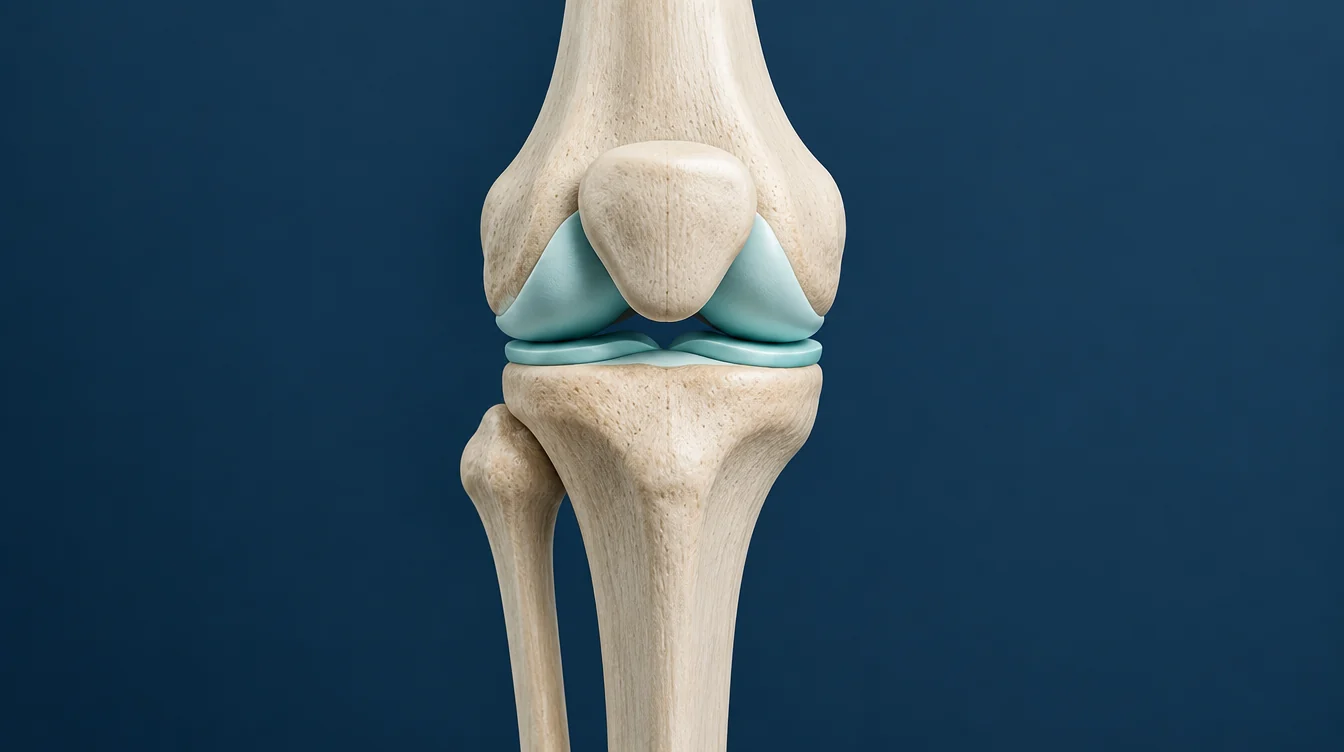
A discrete area where cartilage has been lost, usually from injury — a twisting knee injury, a dislocated kneecap, a piece sheared off in a tackle — in a joint whose remaining surface is largely intact.
It is a young person’s problem far more than osteoarthritis is, and the people who have it are typically active and want to stay that way.
Cartilage has no blood supply and no nerves. It does not heal on its own, and the defect itself does not hurt — pain comes from the exposed bone underneath and from the inflammation the debris provokes.
Untreated, a focal defect raises the risk of later osteoarthritis, which is why there is more appetite to intervene than there is in an older joint with diffuse change. The argument for acting early is about the next thirty years rather than the next six months.
The established alternatives
Microfracture makes small holes in the underlying bone to let marrow contents into the defect, producing fibrocartilage — a repair tissue, mechanically inferior to the original, which tends to deteriorate over years.
Osteochondral transfer moves plugs of bone and cartilage from a less-loaded part of the joint. Autologous chondrocyte implantation harvests cartilage cells, grows them, and implants them in a second operation.
All three are real operations with published outcome data over years, which is more than can currently be said for cell injection here. Each also has known failure modes and known revision rates, which is a form of information an unstudied alternative cannot offer.
Any discussion of an injection should be a comparison against these rather than against nothing.
Why cells are proposed
The rationale is more coherent here than for generalised osteoarthritis: a discrete defect in an otherwise healthy joint is closer to a repair problem than to a chronic inflammatory one.
MSCs are studied both as an injection and as a component of surgical scaffolds, where cells are placed into the defect within a matrix rather than injected into the joint fluid. Those are very different propositions, and the scaffold approach is the one closer to the established cartilage operations.
A mechanistic review covers what the laboratory work supports — Stem cells in articular cartilage regeneration. See MSC immunomodulation for why mechanism alone is not enough.
What the human studies show
A 2025 prospective randomised study examined cartilage regeneration potential specifically, in early knee osteoarthritis — Cartilage Regeneration Potential in Early Osteoarthritis of the Knee: A Prospective, Randomized study.
An older study used cultured bone marrow-derived cells in varus knees with cartilage defects — Injectable cultured bone marrow-derived mesenchymal stem cells in varus knees with cartilage defects — a population closer to this page than most of the osteoarthritis literature.
And a review asked whether biologic injections modify disease rather than symptoms — Biologic injections for osteoarthritis and articular cartilage damage: can we modify disease?, which is precisely the question that matters for a structural defect.
See cartilage regeneration research.
The endpoint problem, sharper here
For osteoarthritis, symptom improvement is a reasonable goal on its own. For a focal defect in a thirty-year-old, the goal is structural — filling the hole with tissue that lasts.
That makes imaging and, ideally, biopsy the meaningful endpoints, and both are used far less often than questionnaires.
A treatment that improves a pain score without filling the defect has not solved the problem this page is about, however welcome the pain relief is. For a young joint the question is whether the surface has been restored well enough to last decades, and a questionnaire cannot answer that.
Who might be considered
Younger patients, a single defect of moderate size, a joint otherwise in reasonable condition, and normal alignment.
Alignment is not a detail. A defect on a surface taking abnormal load will fail whatever is put into it, which is why corrective osteotomy sometimes precedes any cartilage procedure.
Diffuse osteoarthritic change across the joint moves the problem into a different category — see osteoarthritis. Many joints contain both, and which problem dominates decides which approach makes sense.
Realistic expectations
Repair tissue is generally not identical to original cartilage. Even the established surgical techniques mostly produce something that works reasonably and differs structurally.
Rehabilitation is long. Protected weight-bearing for weeks and a graded return to sport over months is standard after cartilage surgery, and any injection claiming to skip that should be questioned.
Return to high-impact sport is possible after the established procedures and is not guaranteed by any of them.
Age matters to the expectation as well. Younger patients with a single traumatic defect do better across every technique studied, and results in older joints with early diffuse change are consistently worse whatever is used.
Questions worth asking
The comparison set here is surgical, which changes the conversation.
- How does this compare with microfracture or chondrocyte implantation for my defect?
- What imaging follow-up is planned, and when?
- Injection into the joint, or cells placed into the defect with a scaffold?
- What is my alignment, and does it need addressing first?
- What rehabilitation is required afterwards?
See MSC therapy and the research library.
Ankle osteoarthritis covers the equivalent problem in the talus, where most of the research is about focal cartilage lesions rather than established arthritis.
Frequently asked questions
Is this the same as osteoarthritis?
No. A focal defect is a discrete hole in an otherwise reasonable surface, usually from injury, and typically in a younger person. The treatment options differ.
Will cartilage grow back?
Not as it was. Repair tissue is generally mechanically inferior to original cartilage, and that holds for the established surgical techniques as much as for injections.
How does it compare with microfracture?
Microfracture has years of published outcome data. Cell injection does not yet. That comparison should be made explicitly rather than avoided.
Does my alignment matter?
Substantially. A defect on a surface taking abnormal load will fail whatever is put into it, which is why corrective surgery sometimes comes first.
What should be measured afterwards?
Imaging, and ideally biopsy. For a structural defect, a pain score alone does not show the problem has been addressed.
Can I return to sport?
Possible after the established procedures and guaranteed by none of them. Rehabilitation runs to months, and an injection does not shorten that.
Requesting a medical evaluation
Nothing on this page establishes whether any treatment is appropriate for you. That needs your history, your imaging and your current medications read by a clinician. If you would like that review, send your records and we will tell you honestly whether there is anything worth discussing — including when the answer is no.
This page is general information, not medical advice, and does not create a doctor–patient relationship. Regenerative treatments discussed here are in most cases investigational. Discuss any treatment with a clinician who knows your history.