On this page
If mesenchymal stromal cells work at all, this is the leading explanation for how. MSC immunomodulation is the proposal that these cells act by signalling to the immune system rather than by becoming new tissue — and it is worth understanding both because it is probably right, and because a mechanism being right does not make a treatment work.
The idea that came first, and did not survive
The original rationale was straightforward: MSCs can be pushed toward bone, cartilage and fat in a laboratory dish, so injecting them into a damaged joint should produce new cartilage.
That model underpinned a great deal of early enthusiasm and most of the marketing language still in use — regeneration, rebuilding, repair.
It has largely not been borne out. Injected cells mostly do not persist, do not engraft in meaningful numbers, and are not found forming new tissue when anyone looks.
A review of stem cells in articular cartilage regeneration set out what the laboratory work does and does not support — Stem cells in articular cartilage regeneration — and a separate review asked directly whether biologic injections modify disease rather than symptoms — Biologic injections for osteoarthritis and articular cartilage damage: can we modify disease?.
What replaced it
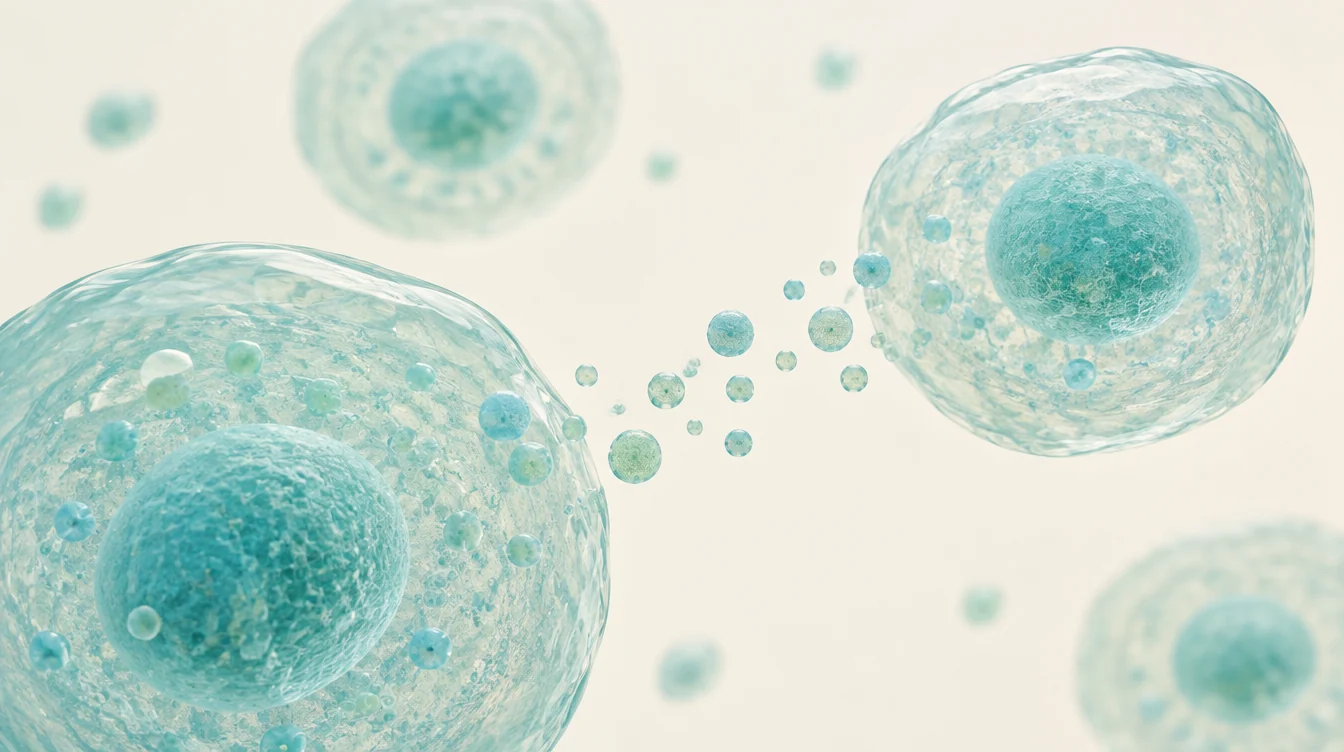
The current model is that MSCs act as short-lived signalling units. They release soluble factors and vesicles that alter the behaviour of the cells already present, particularly immune cells.
Proposed effects include shifting macrophages toward a less inflammatory state, dampening T-cell proliferation, and altering the local cytokine environment.
Each of those is measurable in a laboratory and much harder to demonstrate in a person. Most of the supporting work is cell culture and animal models, which is where mechanism research usually lives.
On this account the cells are not raw material. They are a temporary instruction, and the tissue does whatever repairing occurs itself.
It is a less exciting story than the original one, and it is better supported. That combination is worth noticing, because marketing language tends to track the exciting version long after the research has moved on.
Why the distinction matters commercially
If cells are building blocks, then more cells and better cells should mean more new tissue, and a single large dose might produce lasting structural change.
If cells are a transient signal, then effects should be temporary, repeat dosing should matter, and structural claims are claims about the older model.
The dosing evidence leans toward the second reading — a randomised trial found repeated dosing outperformed a single dose — Repeated MSC Dosing Is Superior to a Single MSC Dose. See MSC dosage research.
Where the model is being tested in humans
Immunomodulation is the rationale behind MSC use in autoimmune and inflammatory disease, and there is a systematic review across that territory — Efficacy and safety of mesenchymal stromal cell transplantation in the treatment of autoimmune and rheumatic immune diseases.
It is also the rationale in metabolic disease — Meta-analysis shows that mesenchymal stem cell therapy can be a possible treatment for diabetes — and in neurological injury, where implants have been trialled for chronic motor deficits after traumatic brain injury — Mesenchymal Stromal Cell Implants for Chronic Motor Deficits After Traumatic Brain Injury.
The word “possible” in that diabetes title is doing real work, and it is the kind of hedge that disappears when findings are summarised on a clinic page.
The lung-trapping problem
Cells given intravenously are largely trapped in the pulmonary capillary bed on first pass. Many do not survive long afterwards.
On the old building-block model this is fatal to the rationale — cells that never reach the knee cannot rebuild it.
On the signalling model it is less damaging, because factors released in the lung can still circulate. But it does mean an intravenous infusion and a direct joint injection are different interventions, whatever they are called.
It also changes how an offer should be read. A clinic proposing an intravenous infusion for a knee is relying on a systemic signalling effect reaching one specific joint — a longer causal chain than injecting that joint directly, and one with correspondingly less evidence behind it.
Mechanism is not efficacy
This is the part worth carrying away. A coherent, well-supported mechanism raises the prior probability that a treatment works. It does not demonstrate that it does.
Medicine has a long list of interventions with excellent mechanistic stories that failed in trials. The biology was not wrong; it was incomplete about what happens in a whole person.
Anti-arrhythmic drugs after heart attack are the standard example. Suppressing abnormal beats was mechanistically sound, widely adopted, and killed more people than it saved when finally tested against placebo. Nobody had been dishonest. The mechanism was simply not the whole story.
Any page that explains how MSCs modulate inflammation and then moves straight to what they will do for your condition has skipped the step where that gets tested — see what the evidence levels mean.
What this means for reading claims
Mechanistic language is the easiest kind to write and the least accountable. Nobody can check “modulates the inflammatory microenvironment” against an outcome.
When you encounter it, ask what happened to patients. If the answer moves back to mechanism, the clinical evidence is probably thin.
A useful test: can the claim be falsified by a trial result? “Modulates inflammation” often cannot, as written. “Reduced pain scores by this much at six months against a sham injection” can, and that is the kind of statement worth looking for.
See MSC therapy for what is actually offered, and the research library for the outcome evidence.
Frequently asked questions
Do injected stem cells become new tissue?
Mostly not. They largely do not persist or engraft in meaningful numbers, which is why the building-block model has been displaced.
So how are they thought to work?
By releasing signals that alter the behaviour of cells already present, particularly immune cells. The tissue does any repairing itself.
Why does that change what I should expect?
A transient signal implies temporary effects and a role for repeat dosing, rather than one large dose producing permanent structural change.
Do intravenous cells reach my knee?
Largely not — most are trapped in the lungs on first pass. That is a reason an infusion and a joint injection are different interventions.
Does a good mechanism mean it works?
No. It makes a treatment worth testing. Medicine is full of excellent mechanisms that failed when properly tested.
Why do clinics talk so much about mechanism?
Because it is easy to write and impossible to check. Ask what happened to patients instead.
Requesting a medical evaluation
Nothing on this page establishes whether any treatment is appropriate for you. That needs your history, your imaging and your current medications read by a clinician. If you would like that review, send your records and we will tell you honestly whether there is anything worth discussing — including when the answer is no.
This page is general information, not medical advice, and does not create a doctor–patient relationship. Regenerative treatments discussed here are in most cases investigational. Discuss any treatment with a clinician who knows your history.