On this page
Exosomes are sold alongside stem cell treatment, often at a similar price, and they are not stem cell treatment. Exosome therapy uses cell-free vesicles rather than living cells — which changes the biology, the regulation and the evidence, and is worth understanding before paying for either.
What an exosome is
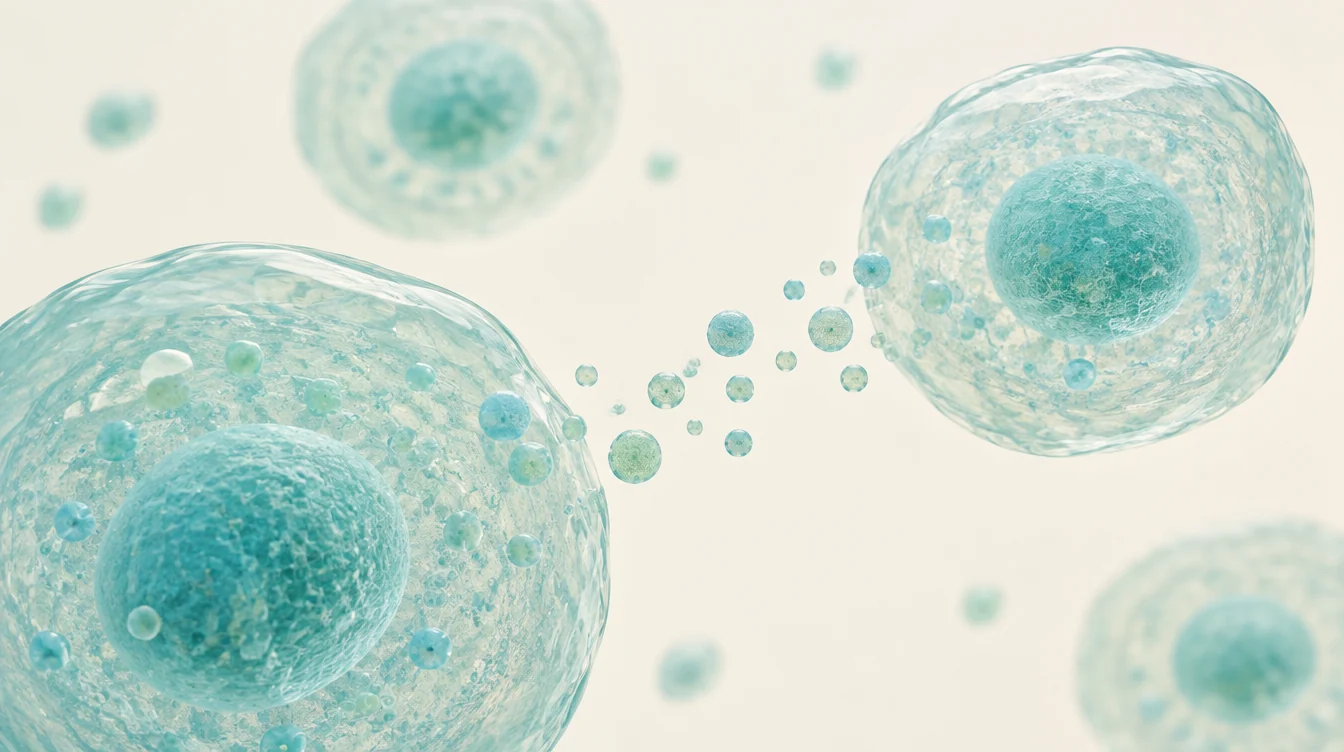
Cells release small membrane-bound packages carrying proteins, lipids and genetic material. These are one kind of extracellular vesicle, and exosome is the term that stuck commercially.
They are not cells. They do not divide, they do not respond to their surroundings, and once given they cannot do anything they were not already loaded with. A cell arriving in an inflamed joint can in principle read that environment and behave differently; a vesicle carries whatever it was packed with and nothing more.
That distinction is the whole basis of the pitch — the signalling without the cells — and also the whole basis of the caution.
Why they are being studied
If MSCs work mainly by secreting signals rather than by becoming tissue, then the signals themselves might be the active ingredient. That is a reasonable hypothesis and a good reason to run trials.
Practically they are also easier to handle than cells: they can be stored and standardised more readily, and they carry no risk of the cells doing something unwanted.
Reasonable hypothesis is where this stands. It is not where the marketing stands.
It is worth noticing that this rationale only holds if the signalling model of how MSCs work is correct. If it is, exosomes are a plausible next step. If the cells do something the vesicles cannot reproduce — responding to the environment they land in, for instance — then the packages are not a substitute for the messenger.
What human evidence exists
Less than for cells, and concentrated in a few narrow indications.
A randomised trial examined cord-derived MSC exosomes injected for knee osteoarthritis — Injection of human umbilical cord mesenchymal stem cells exosomes for the treatment of knee osteoarthritis.
A phase I randomised trial studied nebulised cord MSC-derived extracellular vesicles in pulmonary fibrosis — Clinical investigation on nebulized human umbilical cord MSC-derived extracellular vesicles — and placental MSC-derived vesicles have been assessed for knee osteoarthritis — Safety and efficacy of placental mesenchymal stromal cells-derived extracellular vesicles.
Aesthetic uses are marketed heavily and studied least. Where trials exist they are small, short and rarely blinded, and none of them supports the systemic claims made alongside them.
The standardisation problem
An exosome preparation is not a defined product the way a drug is. What is in it depends on the parent cells, their condition, how the vesicles were isolated and how they were stored.
Isolation methods differ substantially and yield different mixtures. Two products both described as exosomes may have little in common. Ultracentrifugation, precipitation and chromatography each recover different populations of vesicle, and the resulting preparations differ in purity and in what else comes along with them.
This makes cross-trial comparison hard, and makes any claim resting on “exosomes are proven” hard to evaluate at all.
Regulation, which differs from cells
Because exosomes are not living cells, they often fall under different regulatory categories — and in several jurisdictions that has been treated as a gap rather than a permission.
Regulators in multiple countries have issued warnings about unapproved exosome products, and there have been documented adverse events from contaminated preparations. Those events are instructive because they were not failures of the underlying idea — they were failures of manufacturing, in products sold while the manufacturing was unsupervised.
Being available is not the same as being approved — see regulation in Thailand.
How it is given
Intra-articular injection for joints, intravenously for systemic use, topically or by microneedling in aesthetics, and by nebuliser in the pulmonary trial above.
Route matters for the same reason as with cells: the evidence attaches to a route, not to the substance in general.
A topical aesthetic application and an intravenous infusion share a name and very little else. Evidence gathered for one says nothing useful about the other, and pages that cite skin studies beside claims about joints or organs are relying on the reader not noticing.
Risks
The risks are less well characterised than for cells, largely because there is less human data.
Contamination is the documented concern, and it follows directly from the standardisation problem — an unregulated preparation process is where contamination enters.
Because the product is cell-free, some risks associated with living cells do not apply. That is a genuine argument in its favour and it is not an argument that the product works.
The practical difficulty for a patient is that none of this is visible from the outside. Two vials can look identical, cost the same and contain quite different things, and there is no way to tell by looking. That places most of the weight on how the preparation was made and by whom — which is exactly the information hardest to get.
How to weigh it against cell therapy
If you are choosing between them for a joint, the cell evidence is currently deeper — see knee osteoarthritis and MSC therapy.
If you are being offered exosomes as an add-on at additional cost, ask what evidence supports the combination specifically rather than each part separately.
And if exosomes are being described to you as stem cell therapy, that is a factual error worth noticing early — see what the evidence levels mean.
Exosome products are marketed hardest where the evidence is thinnest — telomeres and longevity, cosmetic rejuvenation and chronic fatigue syndrome are three examples.
Frequently asked questions
Are exosomes stem cells?
No, and the distinction is not pedantic. They are cell-free vesicles released by cells. They do not divide, and once given they cannot respond to whatever they land in.
Do they work?
The evidence is mostly laboratory and animal work, with a few early human trials in narrow indications. That is a long way short of established.
Are they safer than cells?
Some cell-associated risks do not apply. Contamination is the documented concern, and the risk profile is less well characterised simply because there is less data.
Why are they cheaper to produce?
No harvest procedure, easier storage and easier standardisation of handling — though not of content, which is the persistent problem.
Are they approved?
In most jurisdictions no, and several regulators have issued warnings about unapproved products. Availability and approval are different things.
Should I add them to a cell treatment?
Ask what evidence supports the combination specifically. Evidence for each separately does not establish anything about the two together.
Requesting a medical evaluation
Nothing on this page establishes whether any treatment is appropriate for you. That needs your history, your imaging and your current medications read by a clinician. If you would like that review, send your records and we will tell you honestly whether there is anything worth discussing — including when the answer is no.
This page is general information, not medical advice, and does not create a doctor–patient relationship. Regenerative treatments discussed here are in most cases investigational. Discuss any treatment with a clinician who knows your history.