On this page
- Why meniscus tears do not heal
- The trial people are quoting
- Cells as an addition to surgery, not a replacement
- What tear you have changes everything
- Mechanical symptoms are a surgical question
- How it is given and what it costs
- What to expect, stated plainly
- What happens to a knee missing part of its meniscus
- Risks
- Frequently asked questions
- Requesting a medical evaluation
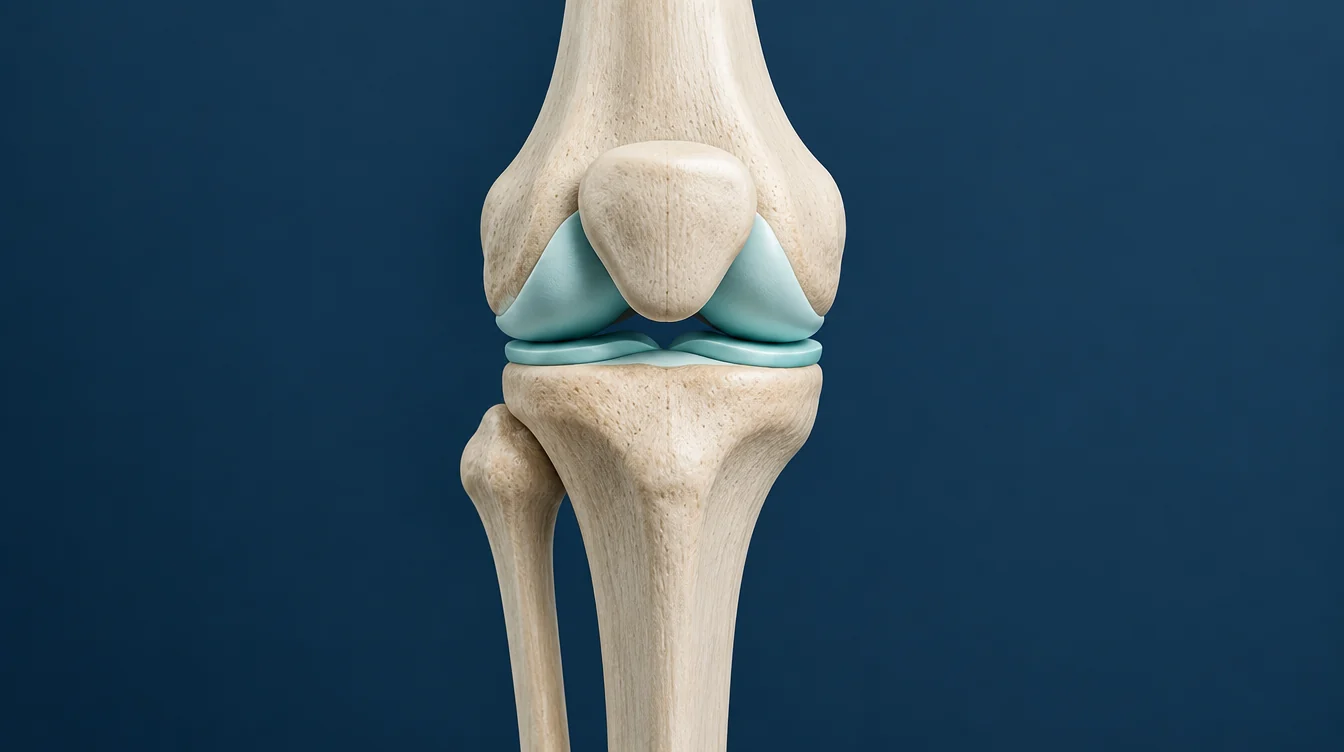
The meniscus is a shock-absorbing wedge of fibrocartilage in the knee, and most of it has no blood supply, which is why tears there do not heal on their own. Stem cell treatment for a meniscus tear is marketed as the repair the body cannot manage. One controlled trial has tested something close to that claim, and its result is more interesting than the marketing.
Why meniscus tears do not heal
Only the outer third of the meniscus carries a blood supply. Tears there — the red zone — sometimes heal, and are the tears surgeons choose to repair.
The inner two-thirds are avascular. Nutrients arrive by diffusion from joint fluid, and there is no bleeding response to recruit repair cells. A tear there stays a tear.
That biology is the entire rationale for injecting cells: supply what the blood supply does not. It is a reasonable idea, which is different from a demonstrated one.
The trial people are quoting
A controlled study injected adult human mesenchymal stem cells into the knee after partial meniscectomy — Adult human mesenchymal stem cells delivered via intra-articular injection to the knee following partial medial meniscectomy.
Note what that describes. Patients had already had torn meniscus tissue surgically removed. The cells were given afterwards, into a joint missing part of its meniscus. This was not an injection instead of surgery.
The study looked at whether meniscal volume increased on imaging and whether symptoms improved. It is small, it is more than a decade old, and it has not been followed by the large confirmatory trial that a positive early result normally attracts. That absence is information.
Cells as an addition to surgery, not a replacement
A systematic review has gathered biologic strategies used to augment meniscal repair — Emerging biologic augmentation strategies for meniscal repair: a systematic review.
The word augmentation is doing real work there. These are techniques applied during or after a surgical repair to improve healing rates, in a setting where a surgeon has already brought the torn edges together.
Nothing in that literature supports injecting cells into an unrepaired tear and expecting the tear to close. The mechanical problem — two separated surfaces under load — is not addressed by an injection.
What tear you have changes everything
A degenerative horizontal tear in a fifty-five-year-old knee with early arthritis is a different condition from a traumatic bucket-handle tear in a twenty-year-old footballer, even though both are called a meniscus tear.
Degenerative tears are common, often incidental on imaging, and frequently not the source of the pain. Several large trials have found that removing them performs no better than physiotherapy for that group.
If your tear is degenerative and your knee also shows arthritic change, the useful reading is knee osteoarthritis — that is where the evidence sits, and it is considerably stronger.
Mechanical symptoms are a surgical question
Locking, catching, or a knee that will not straighten usually means a fragment of meniscus is caught in the joint. That is a mechanical obstruction.
No injection moves a trapped fragment. Delaying an appropriate arthroscopy to try cells first risks further damage to the joint surface while the fragment keeps catching.
This is one of the clearest cases on this site where the honest answer is to see a knee surgeon rather than book a treatment.
How it is given and what it costs
Intra-articular injection into the knee, usually a single dose, occasionally repeated. Cells may be autologous from marrow or fat, or allogeneic from donated cord tissue — see autologous therapy.
Dosing in the published trial was expressed as a total cell count per knee, and doses across this field vary by more than tenfold between studies — MSC dosage research covers why.
Costs in Thailand vary with cell source and the number of doses, and a headline figure rarely includes imaging, follow-up or the harvest procedure. What drives the price sets that out.
What to expect, stated plainly
Possible symptom improvement in a knee that is painful but not mechanically blocked, on evidence from one small controlled study.
No reliable basis for expecting a torn meniscus to knit together after an injection alone.
If a clinic shows you an image of regrown meniscal tissue, ask which study it comes from, how many patients were in it, and what happened to the ones who did not improve.
What happens to a knee missing part of its meniscus
Removing torn meniscal tissue relieves mechanical symptoms and also reduces the joint’s shock absorption. Less meniscus means higher contact pressure on the cartilage beneath it.
Over years, that raises the likelihood of arthritic change in the same compartment. It is one reason surgeons now preserve meniscus wherever a repair is possible, and remove as little as they can when it is not.
That long horizon is where the regenerative question genuinely lives. If cells could restore meniscal volume after a partial removal, the benefit would be measured in cartilage preserved decades later, not in pain scores at six months. No study has followed patients long enough to answer that, and none is close to doing so.
Risks
Infection in the joint after injection — uncommon, serious, and time-critical.
A swollen, painful knee for several days is usual. Persistent or worsening symptoms are not, and should be assessed.
Harvest-site pain and bruising where your own cells are used. The limits of current evidence covers what is not yet known about longer-term outcomes.
Frequently asked questions
Can an injection repair my torn meniscus?
No published trial has shown a tear closing after an injection alone. The controlled study that exists gave cells after surgical removal of torn tissue.
My knee locks. Should I try this first?
Locking usually means a fragment is caught in the joint, which is a mechanical problem an injection cannot address. See a knee surgeon.
What if my tear is degenerative?
Then the pain may be arthritic rather than from the tear, and the osteoarthritis evidence is the relevant reading — it is also considerably stronger.
Why has the trial not been repeated?
That is a fair question to put to any clinic quoting it. A promising early result that attracts no confirmatory trial over a decade is worth noticing.
Is it better than physiotherapy?
No study has compared them directly for this indication, so nobody can answer that from data.
Does it work in the avascular zone?
That is the hypothesis behind the treatment. It has not been demonstrated in a controlled trial of injection into an unrepaired tear.
Requesting a medical evaluation
Nothing on this page establishes whether any treatment is appropriate for you. That needs your history, your imaging and your current medications read by a clinician. If you would like that review, send your records and we will tell you honestly whether there is anything worth discussing — including when the answer is no.
This page is general information, not medical advice, and does not create a doctor–patient relationship. Regenerative treatments discussed here are in most cases investigational. Discuss any treatment with a clinician who knows your history.